Online Umrah Taxi

Ash-Shuhada (Sayyid al-Shuhada), Madinah: Uhud Martyrs’ Cemetery & Visitor Guide
The Uhud martyrs’ cemetery at the foot of Mount Uhud: the battle, who is buried there, what you can see today and how to visit respectfully.
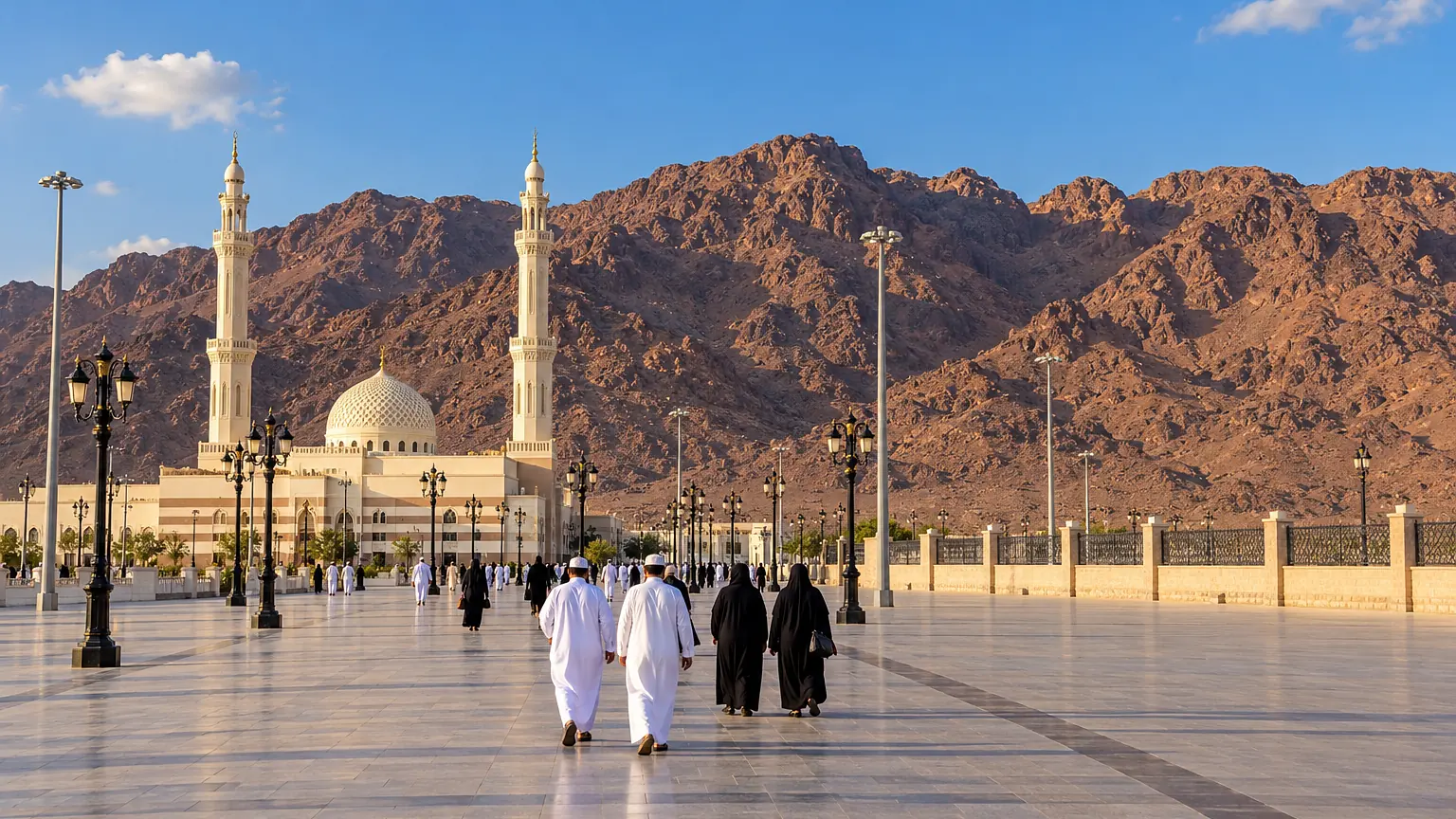
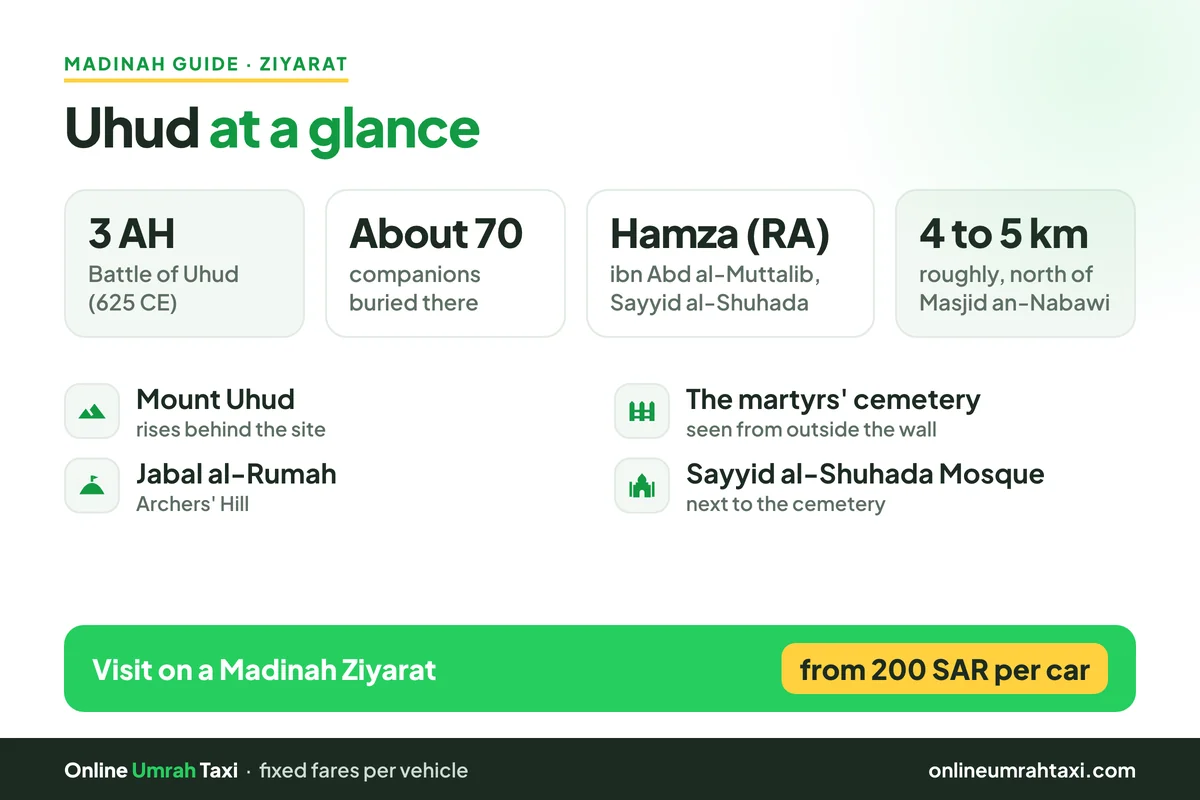
Ash-Shuhada, or Sayyid al-Shuhada, is the area at the foot of Mount Uhud in Madinah where about seventy companions martyred at the Battle of Uhud (3 AH) are buried, including Hamza ibn Abd al-Muttalib (RA). It lies roughly 4 to 5 km north of Masjid an-Nabawi. Online Umrah Taxi’s Madinah Ziyarat, which can include Uhud, starts at 200 SAR per car.
Shuhada (الشهداء) is Arabic for “the martyrs”. Sayyid al-Shuhada means “the master of the martyrs”, a title given to Hamza (RA), the uncle of the Prophet ﷺ. In Madinah, both names refer to the Uhud martyrs’ cemetery, its mosque and the battlefield around it.
This guide covers the history of Uhud, what you can see there today, how to visit respectfully, and how to fit it into a Madinah Ziyarat.
Quick facts
| Also known as | Sayyid al-Shuhada, Sayed ash Shuhada, Shuhada Uhud, Uhud Martyrs’ Cemetery |
|---|---|
| Location | At the foot of Mount Uhud, north of central Madinah |
| Distance from Masjid an-Nabawi | Roughly 4 to 5 km (a short drive) |
| Event | Battle of Uhud, Shawwal 3 AH (625 CE) |
| Who is buried there | About seventy companions, including Hamza ibn Abd al-Muttalib, Abdullah ibn Jahsh and Mus’ab ibn Umair (RA) |
| What you can see | The martyrs’ cemetery, Sayyid al-Shuhada Mosque, Jabal al-Rumah (Archers’ Hill) and Mount Uhud |
| Ziyarat with Online Umrah Taxi | Madinah Ziyarat from 200 SAR (Toyota Camry) |
What does Ash-Shuhada mean?
Ash-Shuhada means “the martyrs” in Arabic. It is the plural of shaheed, a person who dies as a martyr.
In Madinah, the name refers to the martyrs of the Battle of Uhud and the place where they are buried. The area is also called Sayyid al-Shuhada, after the title of Hamza ibn Abd al-Muttalib (RA).
The name Ash Shuhada is also used for districts in other Saudi cities, including Riyadh. If you are looking for the Uhud martyrs, you want the site at Mount Uhud in Madinah.
The Battle of Uhud (3 AH)
The Battle of Uhud took place in Shawwal 3 AH (625 CE), about a year after the Battle of Badr. An army from Makkah marched on Madinah, and the Muslims met it at the foot of Mount Uhud.
The Prophet ﷺ placed around fifty archers on a small hill, now called Jabal al-Rumah or Archers’ Hill, under Abdullah ibn Jubayr (RA). They were told not to leave their position. When the battle seemed won, many of the archers came down. The Makkan cavalry rode around the hill and attacked from behind.
About seventy companions were martyred that day, and the Prophet ﷺ was wounded. The battle is remembered as a lesson in discipline, patience and trust in Allah. The Qur’an discusses it in Surah Aal Imran.
Visit Uhud on a Madinah Ziyarat: from 200 SAR
Online Umrah Taxi’s Madinah Ziyarat picks you up at your hotel and can include Mount Uhud and the martyrs’ cemetery, Masjid al-Qiblatain and Masjid Quba. The fare is per vehicle, and you confirm your list of stops on WhatsApp before the day.
- Hotel pickup and drop-off in Madinah
- Stops agreed with you in advance, with time to pray
- English- and Arabic-speaking driver who knows the Ziyarat sites
- Air-conditioned car with bottled water
| Vehicle | Seats | Fixed fare |
|---|---|---|
| Toyota Camry | 4 | 200 SAR |
| Hyundai Staria | 7 | 280 SAR |
| GMC Yukon XL | 7 | 300 SAR |
| Chevrolet Suburban | 7 | 450 SAR |
| Toyota Hiace | 11 | 370 SAR |
| Toyota Coaster | 17 | 400 SAR |
Book on WhatsAppMadinah Ziyarat taxi details
Fares are per vehicle, not per person. Pay the driver in cash or by secure online link.
Who is buried at the Uhud martyrs’ cemetery?
The martyrs of Uhud were buried close to where they fell. The best-known graves are those of:
- Hamza ibn Abd al-Muttalib (RA), the uncle of the Prophet ﷺ, known as Sayyid al-Shuhada.
- Abdullah ibn Jahsh (RA), a cousin of the Prophet ﷺ, buried in the same grave as Hamza (RA).
- Mus’ab ibn Umair (RA), the first envoy of Islam to Madinah, who carried the Muslim banner at Uhud.
The graves are inside a walled enclosure. Visitors stand outside the railings to offer greetings and make du’a for the martyrs.
The grave of Hamza (RA), Sayyid al-Shuhada
Hamza ibn Abd al-Muttalib (RA) was the uncle of the Prophet ﷺ and one of the earliest defenders of Islam in Makkah. He was martyred at Uhud and is known by the title Sayyid al-Shuhada, the master of the martyrs.
Hamza (RA) is buried in the Uhud martyrs’ cemetery, sharing a grave with his nephew Abdullah ibn Jahsh (RA). Many visitors search for “Hamza grave” or “Hazrat Hamza grave”. It is this same site, and you see it from the railings with the other martyrs’ graves.
 Open the full-size image
What you can see at Ash-Shuhada today
The area around the cemetery has been redeveloped in recent years, with walkways, parking and visitor facilities.
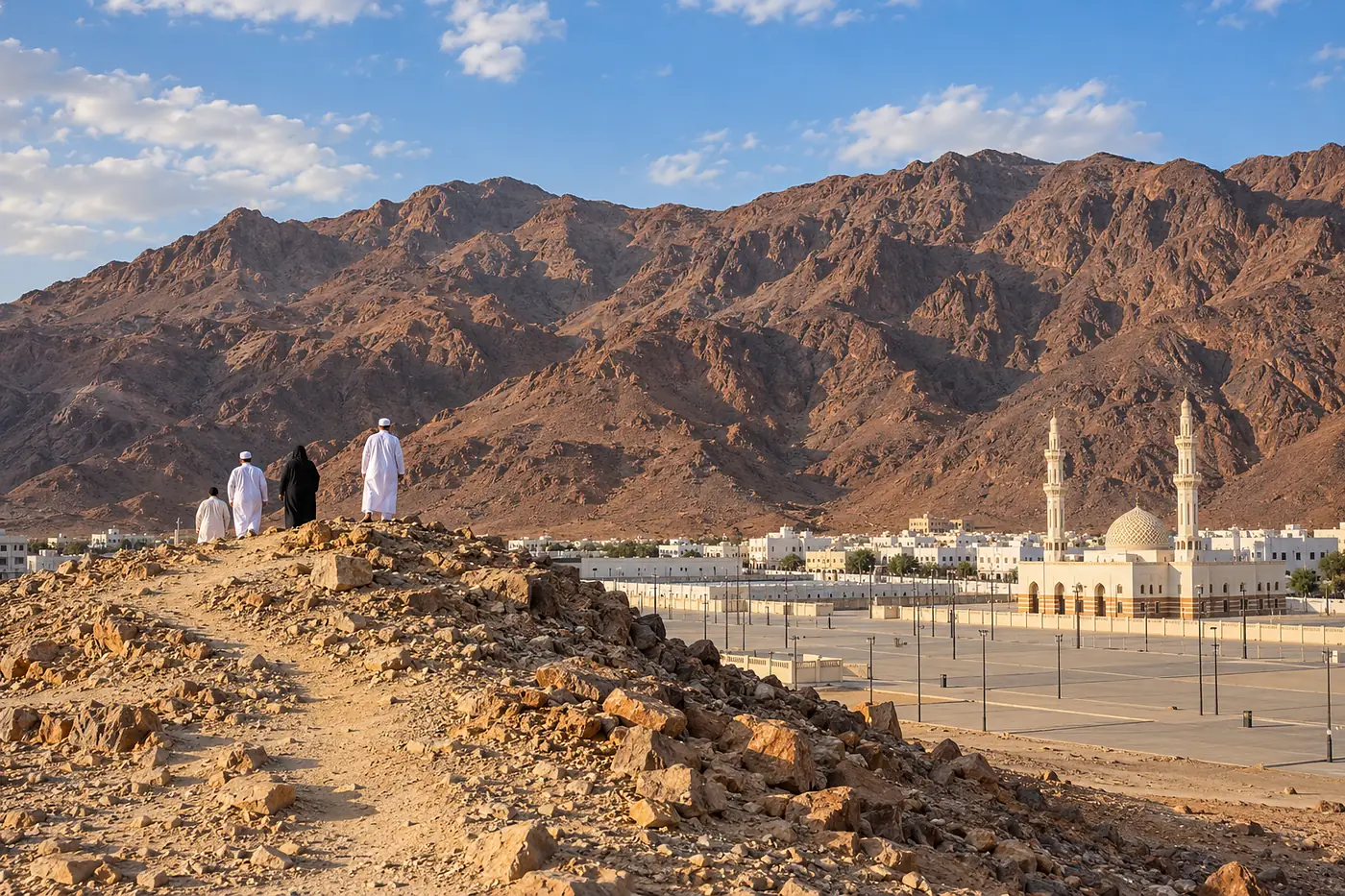
The martyrs’ cemetery
The cemetery is the heart of the site. Most visitors spend a few quiet minutes here offering salam and du’a.
Sayyid al-Shuhada Mosque
A large mosque stands next to the cemetery. Many visitors pray here before or after visiting the graves.
Jabal al-Rumah (Archers’ Hill)
The small hill where the archers stood is opposite the cemetery. Many visitors climb it for a view of the battlefield and Mount Uhud.
Mount Uhud
Mount Uhud rises behind the site. The Prophet ﷺ said of it: “Uhud is a mountain that loves us and we love it.” The narration is in Sahih al-Bukhari.
Visiting etiquette
Ash-Shuhada is a cemetery and a place of reflection. Keep your voice low and dress modestly.
- Offer the greeting to the people of the graves and make du’a for the martyrs, as taught in the Sunnah.
- Follow the signs and the guidance of the staff on site, including any rules on photography.
- Keep to the walkways and do not climb on the walls or railings.
- Go early in the morning in summer. The site is open and there is little shade at midday.
Practices at graves are a matter for your scholar. This guide keeps to general visiting advice.
How to get to Ash-Shuhada from Masjid an-Nabawi
Ash-Shuhada is roughly 4 to 5 km north of Masjid an-Nabawi. The drive is short, but walking there is long and hot for most visitors.
| Option | Good for | Things to know |
|---|---|---|
| Madinah Ziyarat with Online Umrah Taxi | Families and groups who want several sites in one trip | From 200 SAR per car. Uhud, Qiblatain and Quba in one planned route. |
| City bus or hop-on tour bus | Solo travellers | Routes change by season. Check the current route to Uhud before you go. |
| Street taxi or app | A quick one-way ride | Often available near the Haram. You may need another car to come back or continue. |
Fitting Uhud into a Madinah Ziyarat
Most pilgrims visit Uhud as part of a morning Ziyarat. A common plan is to pray Fajr at Masjid an-Nabawi, visit Uhud while it is cool, then continue to Masjid al-Qiblatain and Masjid Quba.
Tell your driver which places matter most to you, and how long you would like at each. Online Umrah Taxi agrees the stops on WhatsApp before the day, so there is no rush once you are there.
Pilgrims who also want to see Wadi-e-Jinn can book the Madinah Ziyarat including Wadi-e-Jinn, which starts at 300 SAR in a Toyota Camry.
Frequently asked questions
What is Ash-Shuhada in Madinah?
Ash-Shuhada is the site at the foot of Mount Uhud where about seventy companions martyred at the Battle of Uhud in 3 AH are buried. It includes the martyrs’ cemetery, Sayyid al-Shuhada Mosque and Archers’ Hill.
Who is Sayyid al-Shuhada?
Sayyid al-Shuhada, “the master of the martyrs”, is the title of Hamza ibn Abd al-Muttalib (RA), the uncle of the Prophet ﷺ. He was martyred at Uhud and is buried there.
Where is the grave of Hazrat Hamza (RA)?
The grave of Hamza ibn Abd al-Muttalib (RA) is in the Uhud martyrs’ cemetery at Ash-Shuhada, roughly 4 to 5 km north of Masjid an-Nabawi. There is no separate site to visit.
How far is Uhud from Masjid an-Nabawi?
The Uhud martyrs’ site is roughly 4 to 5 km north of Masjid an-Nabawi, a short drive.
How many martyrs are buried at Uhud?
About seventy companions were martyred at the Battle of Uhud and buried at the site.
Can you go inside the Uhud cemetery?
The graves are inside a walled enclosure. Visitors stand at the railings outside to offer greetings and make du’a.
How much is a taxi to Uhud?
A private Madinah Ziyarat that stops at Uhud starts at 200 SAR in a Toyota Camry, for the whole car. Larger vehicles and the usual stops are on our Madinah Ziyarat taxi page.
What is the best time to visit Ash-Shuhada?
Early morning is usually best. It is cooler and calmer, and many visitors go straight after Fajr.
Related guides and rides
- Madinah Ziyarat taxi: hotel pickup, stops agreed in advance
- Wadi e Jinn taxi: Ziyarat including Wadi-e-Jinn from 300 SAR
- Madinah taxi: rides around Madinah
- Makkah to Madinah taxi: getting to Madinah
This guide gives general information for visitors. For rulings on visiting graves and related practices, please follow your scholar.
Sources
- Mount Uhud (Wikipedia)
- Battle of Uhud (Wikipedia)
- Sayed as-Shuhada, Medina (Madain Project)
- Sayed Al-Shuhada Mosque, a historic landmark in Madinah (Arab News)
Written by the Online Umrah Taxi team. Last reviewed 29 September 2026.